01Human presence
How can a system establish that the expected human is physically present for a specific action?
Identity, access and agent authorization—without treating a reusable digital signal as final authority.

Digital intelligence cannot be solely responsible for constraining itself. 4SI studies how physical evidence can establish the human, object and authority behind consequential action.
 Physical structure
 Observable state
 Observable physical state
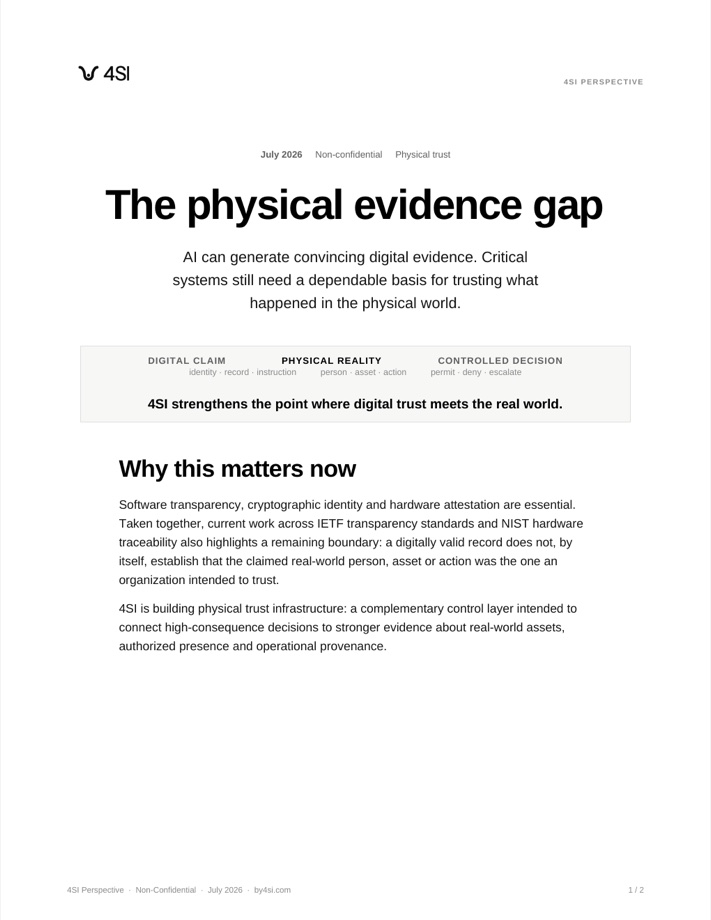
The program is deliberately narrow. We focus on the points where a valid digital claim can still be disconnected from the physical person, object or authority it is meant to represent.
Identity, access and agent authorization—without treating a reusable digital signal as final authority.
Products, components and sealed assets across manufacturing, handoff, installation and use.
Before money moves, access is granted, control transfers or software causes a physical action.
Measured against deployment friction, failure modes, assurance level and the value of the decision.
4SI PERSPECTIVE · JULY 2026
Why digitally valid evidence is not enough for high-consequence systems.
Long-form papers are paired with persistent Zenodo records. The economic note connects the same control problem to observable loss and deployment economics.
20 JULY 2026 · FRONTIER AI GOVERNANCE
Why consequential AI execution requires an enforceable verification boundary—not another advisory layer.
21 JULY 2026 · CYBER-PHYSICAL ASSURANCE
An information-theoretic framework for verification in autonomous action systems and the assurance gap between a valid record and its physical referent.
16 JULY 2026 · ECONOMIC ASSURANCE
Primary-source evidence on fraud, counterfeit trade, weak authorization and the conditions under which physical trust infrastructure can change loss economics.
4SI research is designed to remain useful under scrutiny. Public evidence, 4SI analysis, testable hypotheses and product claims are treated as different categories.
Prefer direct, official and persistent records. Identify the provenance and date of every material claim.
Distinguish documented fact from inference, proposed control logic and future product capability.
State assumptions, boundary conditions, limitations and the failure modes a control does not resolve.
Publish versioned records and DOI-backed papers where durable citation improves shared understanding.
Questions, evidence, models and bounded conclusions.
Technical performance, architecture and adversarial evaluation.
Measured outcomes inside a defined institutional workflow.
4SI works with institutions that can define a consequential workflow, the authority it depends on and the evidence required to judge whether a physical verification boundary improves it.